

MPS and Land Use Bylaw Review
Municipal Planning Strategy and Land Use Bylaw Review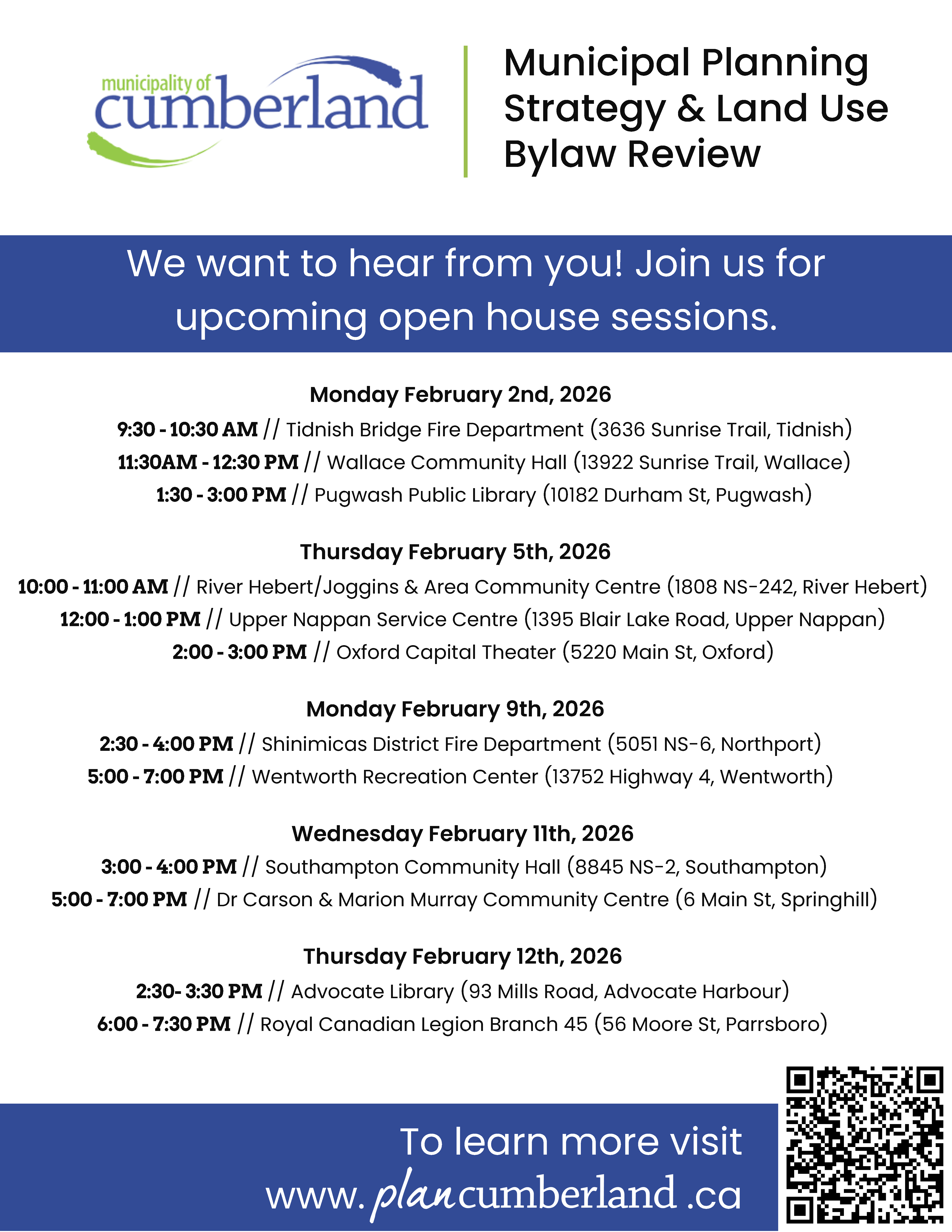
Project Status: ACTIVE
Quick Links
- Introduction
- Priority: Coastal Resilience and Protection
- Priority: Housing and Balanced Neighbourhoods
- Priority: Rural and Agricultural Land Use
- Priority: Framework for Renewable Energy
- Video
- Engagement Opportunities
- Project Updates
- Contact Us
- Partners
- Project Timeline
- Frequently Asked Questions
- Documents
Interested in learning more about the project and sharing your thoughts on the preliminary policy recommendations? We invite you to join us at one of our open houses. Click the image to open or download the Open House Session Information in a new window.
Introduction
The Municipality of the County of Cumberland is undertaking a focused and strategic update of its Municipal Planning Strategy (MPS) and Land Use Bylaw (LUB).
This project is a targeted review designed to address emerging challenges and opportunities across our community. The goal is to update policies and bylaws to ensure they are modern, practical, and fully align with Nova Scotia’s Statements of Provincial Interest.
This strategic update will focus on four crucial areas identified as “Priority Themes” to support best planning practices and secure a sustainable future for all who live, work, and operate here. We are seeking public feedback and working to implement improved land use policies across these four priority themes:
Coastal Resilience & Protection
The Municipality is defining its own comprehensive approach to managing our extensive coastline. With over 850 km of coastline at risk from sea-level rise, storm surges, and coastal erosion, our policies must adapt to protect public safety and valuable coastal properties.
Goal: Develop robust municipal policies to address the growing risks of coastal erosion and flooding due to climate change, securing a safer future for our coastal communities.
Housing & Balanced Neighbourhoods
To respond to our recent population growth and the resulting housing deficit, we need to enable a greater diversity of housing options. This review focuses on creating zoning solutions that enable higher-density housing in areas with central services while balancing development with the preservation of existing neighbourhood character.
Goal: Explore zoning solutions to increase the supply of diverse and affordable housing options in serviced areas, supporting complete and livable communities.
Rural & Agricultural Land Use
This review aims to refine the application of agricultural zoning across the Municipality. Currently, many parcels are zoned for agriculture based only on soil class, not on active use, size, or suitability for farming. This has restricted other forms of rural development in some areas and resulted in loss of highly productive farmland near urban areas.
Goal: Refine agricultural zoning to better protect truly productive farmland and formally identify agricultural marshland conservation areas, while freeing up other rural lands for appropriate development.
Framework for Renewable Energy
Cumberland County has been identified as an ideal location for renewable energy, leading to an increased number of applications for wind and solar farm developments. This creates an urgent need for clear, detailed regulations.
Goal: Establish a modern, regulatory framework that guides the placement and scale of commercial renewable energy projects (including wind, solar, and emerging technologies like green hydrogen) while balancing energy goals with community and environmental protection.
Municipal Planning Strategy and Land Use Bylaw Review Video
Engagement Opportunities
Interested in learning more about the project and sharing your thoughts on the preliminary policy recommendations? We invite you to join us at one of the following open houses:
Monday February 2nd, 2026
- 9:30-10:30AM // Tidnish Bridge Fire Department (3636 Sunrise Trail, Tidnish, NS)
- 11:30AM-12:30PM // Wallace Community Hall (13922 Sunrise Trail, Wallace, NS)
- 1:30-3:00PM // Pugwash Public Library (10182 Durham St, Pugwash, NS)
Thursday February 5th, 2026
- 10:00-11:00AM // River Hebert/Joggins & Area Community Centre (1808 NS-242, River Hebert, NS)
- 12:00-1:00PM // Upper Nappan Service Centre (1395 Blair Lake Road, Upper Nappan, NS)
- 2:00-3:00PM // Oxford Capital Theater (5220 Main St, Oxford, NS)
Monday February 9th, 2026
- 2:30-4:00PM // Shinimicas District Fire Department (5051 NS-6, Northport, NS)
- 5:00-7:00PM // Wentworth Recreation Center (13752 Highway 4, Wentworth NS)
Wednesday February 11th, 2026
- 3:00-4:00PM // Southampton Community Hall (8845 NS-2, Southampton, NS)
- 5:00-7:00PM // Dr Carson & Marion Murray Community Centre (6 Main St, Springhill, NS)
Thursday February 12th, 2026
- 2:30-3:30PM // Advocate Public Library (93 Mills Road, Advocate Harbour, NS)
- 6:00-7:30PM // Royal Canadian Legion Branch 45 (56 Moore St, Parrsboro, NS)
Project Updates
Check back for ongoing updates throughout the planning process.
Contact Us
Glen Boone, Director of Development and Planning
Kira Norgren, Municipal Planner and Development Officer
Partners
Dillon Consulting Ltd is the lead planning consultant for this project. They will provide expertise on policy analysis and development as well as technical insights from water resource engineers, linear municipal infrastructure experts, and other development professionals.
The planning team from FBM Architecture Ltd is the partner consultant leading the public engagement process. They are working closely with Dillon Consulting and Cumberland County to facilitate and incorporate ongoing public and stakeholder feedback on priority themes.

Project Timeline
Project Start Date: Spring 2025
Dillon Consulting and FBM were selected as consultants for the project.
Background Review: Summer – Fall 2025
Planning document analysis, data collection, and site visits were undertaken to produce technical memos.
Community Engagement: Winter 2025/2026
Two preliminary pop-up engagements were held at the Parrsboro and Pugwash Farmers Markets in August 2025. Ongoing public consultation and stakeholder engagement will take place in Winter 2025/2026. Upcoming engagement opportunities will be communicated to the public as they become available.
Draft Policy and Regulation Development: Spring 2026
Community needs, council direction, and technical analysis will be translated into draft policy documents for review by municipal staff, council, and community stakeholders.
Plan Presentation, Revisions, and Approval: Spring – Summer 2026
The draft policy will be formally presented to council and the public, revisions will be made based on final feedback, and the MPS and LUB will be prepared for adoption.
Frequently Asked Questions
Q: What is the purpose of the Municipal Planning Strategy and Land Use Bylaw?
A: The Municipal Planning Strategy (MPS) and Land Use Bylaw (LUB) are the two core documents that manage and guide all development in the Municipality.
The Municipal Planning Strategy is a high-level policy document containing Council’s long-term vision and goals for future growth (e.g. increasing housing supply, managing coastal risk, protecting farmlands). It sets the strategic direction and must align with Nova Scotia’s Statements of Provincial Interest.
The Land Use Bylaw is the detailed regulatory companion that makes the MPS policies enforceable on the ground. It divides the Municipality into zones (e.g. Residential, Commercial) and provides the specific rules for development, such as permitted uses, building height, and lot size.
Q: Why are the Municipal Planning Strategy and Land Use Bylaw being reviewed?
A: The MPS and LUB are being reviewed to address urgent challenges like the housing shortage and climate change, and to ensure our regulations align with the current needs of Cumberland residents and Provincial requirements.
Q: How will my feedback be integrated into the review process?
A: Public feedback is a vital part of this process. Feedback from workshops, community info sessions, and pop-up engagement events will be summarized in a 'What We Heard' report. The consulting team (Dillon and FBM) will use this input to refine the draft policies before they are presented to municipal staff and Council.
Q: I am currently applying for a building permit (or plan to soon). Will this review pause or affect my application?
A: No. Applications are reviewed based on the bylaws in effect at the time the application is deemed complete. The new rules will not apply until the review is complete and officially adopted by Council.
Q: Does a "Targeted Review" mean only specific areas of the Municipality are being looked at?
A: Not necessarily. While the review is "targeted" in scope, meaning it focuses specifically on the four priority themes (Coastal, Housing, Agriculture, Energy), the changes may apply to properties across the entire Municipality. For example, new rules regarding renewable energy or coastal setbacks could apply to any relevant property in Cumberland County, whereas housing density changes might focus mostly on serviced areas.
Documents
Official documents for the MPS and LUB review process will be shared here on an ongoing basis.
Inquiries Related to a Planning Project
Inquiries Related to My Property
Municipal Governance & Electoral Boundary Review
On November 27, 2019, Council made the decision to reduce the number of Councillors to 8, and switch to a Mayor for council leadership. Follow the links below for the new districts:
The Nova Scotia Utility and Review Board (NSUARB), following a hearing on February 20, 2020, approved the application for the change in council districts and leadership in their April 16, 2020 decision, available here:
pdf Notice of Public Hearing - February 20, 2020(28 KB)
Municipal Governance & Electoral Boundary Review
Free and fair elections are the cornerstone of democracy in Nova Scotia. Municipalities play a vital role in the electoral process by recommending the size of municipal council and the polling districts from which municipal councillors are elected. Municipalities also choose whether municipal leadership is an elected Mayor or an appointed Warden.
Following the dissolution of the Town of Parrsboro, the Municipality of Cumberland has been asked by the Nova Scotia Utility and Review Board (NSUARB) to conduct another electoral boundary review to address variances in the number of voters in polling districts.
Two-Step Process
In conducting this report, staff are following the two-step process recommended by the NSUARB.
Step 1
Council first determines the desired number of councillors (i.e., the size of council) and whether leadership should continue with a Warden or switch to a Mayoral system.
Determining the size of council involves the consideration of the desired style and governance structure of Council, and a determination of an effective and efficient number of councillors. The NSUARB suggests that the style of government is a question which should not be decided by council until adequate public consultation has occurred respecting the expectation of its constituents. The size of council and its governance structure is a matter which can then be determined by Council in an informed debate.
Step 2
The distribution of polling districts and their boundaries should be addressed in the second stage. Several factors must be addressed when determining boundaries of polling districts, including the number of electors, relative parity of voting power, population density, community of interest and geographic size.
The Nova Scotia Utility and Review Board has determined that in municipal boundary review applications, the target variance for relative parity of voting power must be ±10% from the average number of electors per polling district or ward. Any variance in excess of ±10% must be justified in writing. The larger the proposed variance, the greater the burden on the municipality to justify the higher variance.
2019 Cumberland Governance and Electoral Boundary Review Process
Following several months of public engagement and research, Planning staff presented a report on Leadership and Council Size to Council on November 4, 2019. At that meeting, Council voted to reduce the number of Councillors from 13 to 8 and switch to a Mayor for Council Leadership.
In this second part of the process, polling district boundary options have been prepared for review and comments by the public and Council. Two or three final boundary options will be presented to Council on November 27th, when they will make a decision on which option they feel is most suitable.
Planning staff have prepared four preliminary boundary options for public comment. Public comments will be shared with Council who will make a determination of which scenario they wish to use in an application to the NSUARB.
Follow the links below to view our draft electoral boundaries, and leave your feedback!
The CBC article, The tiny Nova Scotia towns with lots of politicians, but not many people, provides some good background and context on rural municipal governance.
Mechanic Street Park
Parrsboro Facility Needs Assessment
The Parrsboro Facility Needs Assessment is a project that looks at the buildings and spaces used by the community in Parrsboro, Nova Scotia. The goal is to see if these facilities are meeting people’s needs now and if they will still be useful in the future. By checking what Parrsboro already has and what might be missing, the assessment helps local leaders make good decisions about improving or adding new community spaces. This way, Parrsboro can make sure its facilities support everyone in the community, both now and as the town grows.